The age of AI agents has arrived. What’s changed is not the promise, but the proof.
For years, AI lived in the realm of pilots and headlines. Now it’s showing up in P&Ls. A recent PwC CEO survey found that 30% of CEOs are already seeing revenue gains from AI. At the same time, more than half report no meaningful financial impact. The signal is clear: value is real, but it is not evenly distributed.
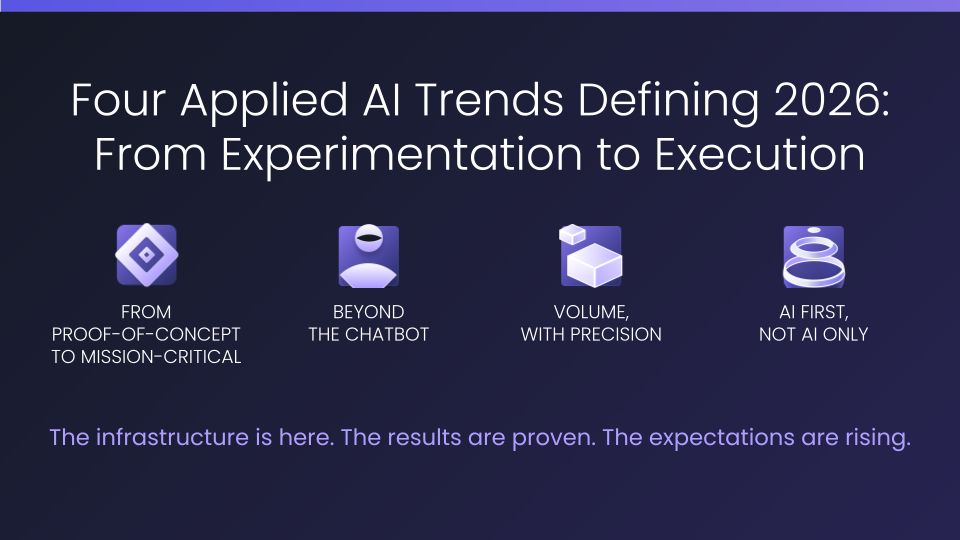
The difference is no longer access to technology. It is how AI is applied. At Pypestream, we see four trends defining how enterprise AI agents move from curiosity to competitive advantage.
From Proof-of-Concept to Mission-Critical
AI is no longer a sandbox initiative. It is core infrastructure for growth, efficiency and customer experience. The organizations pulling ahead have made a simple but important shift. They are no longer asking, “Where can we try AI?” They are asking, “Where must AI perform?”
That shift changes everything. It forces alignment with real business processes, real KPIs, and real accountability.
When AI is embedded into customer-facing workflows, outcomes follow. Pypestream clients are already seeing double-digit improvements in engagement, resolution rates, and CSAT. Not because the technology is novel, but because it is deployed where it matters.
AI is not an experiment anymore. It is an expectation.
Beyond the Chatbot: AI as an Execution Layer
The term “chatbot” is over. AI agents have evolved from simple conversational interfaces into complex execution engines. They do not just respond to requests. They complete them.
This is the difference between answering a question about a claim and actually processing the claim. Between explaining a policy and upselling based on need. Between routing a request and resolving it.
That shift is powered by deep integration into back-office systems like Salesforce, Guidewire, and other systems of record. AI is no longer sitting on the surface of the business. It is operating within it. The result is end-to-end resolution within a single interaction. No handoffs. No dropped context. No unnecessary friction.
AI is less like a tool and more like infrastructure.
Volume, with Precision
Handling volume was never the real challenge. Accuracy is. Most organizations that experimented with AI learned quickly that scaling interactions is easy. Scaling them correctly is not.
Enterprise tolerance for error is shrinking. Leaders are no longer willing to accept systems that produce unpredictable results, hallucinate, or introduce risk into customer interactions. The new standard is clear: accuracy above 90%, with failure and hallucination rates below 1%. This is what enterprise-grade AI looks like in practice.
At Pypestream, our platform supports more than 50 million AI-enabled customer interactions every month while exceeding those thresholds. That scale, combined with precision, is what turns AI from a novelty into a dependable operational layer.
Because at enterprise scale, “mostly right” is still wrong.
AI-First, Not AI-Only
One of the most important shifts happening right now is philosophical. For a while, the market leaned toward making everything AI-powered. That approach is giving way to something more pragmatic and more effective. AI-first does not mean AI everywhere.
It means using AI where it adds value and relying on deterministic systems where certainty is required. Some tasks demand absolute precision. Identity verification. Eligibility rules. Payments. Compliance workflows. These are not areas for interpretation. They require rule-based automation that executes exactly as designed.
Other moments benefit from AI’s strengths. Understanding intent. Interpreting nuance. Recommending next best actions. Managing complex, multi-turn conversations. The organizations seeing real ROI are the ones that combine both.
Pypestream’s approach integrates deterministic workflows with AI agents within the same system. This allows enterprises to move seamlessly between certainty and reasoning, delivering outcomes that are both intelligent and reliable.
Especially in regulated or brand-sensitive environments, this balance is essential.
Closing the Gap Between Potential and Performance
The gap between organizations seeing AI results and those still waiting is not about ambition. It is about execution. Many companies say they are ready for AI. Far fewer have connected the underlying pieces, including clean data, integrated systems, defined workflows, and governance models that allow AI to operate effectively.
An AI agent without context is just guesswork at scale. The enterprises pulling ahead have done the unglamorous work. They have aligned data, systems, and strategy so AI can act with precision and purpose.
The infrastructure is here. The results are proven. The expectations are rising. The only question left is whether AI in your organization is still being tested, or whether it is already delivering.