In nearly every AI training session I run, someone eventually asks a version of the same question: “How do you actually know if my AI agent is working how we want it to?” It’s the right question, and one that many organizations still struggle to answer clearly. “Trust the model” isn’t an acceptable answer. And metrics like perplexity scores or F1 rates, while useful for engineers building foundation models, mean little to a CMO trying to understand whether AI is improving customer experiences or to a CFO evaluating return on investment.
What business leaders actually care about is much simpler: Are customers getting their issues resolved? Is call volume decreasing while CSAT improves? Is the AI saying anything that could introduce risk or damage the brand? Answering those questions requires a very different kind of evaluation framework, one built around real-world outcomes rather than model performance alone.
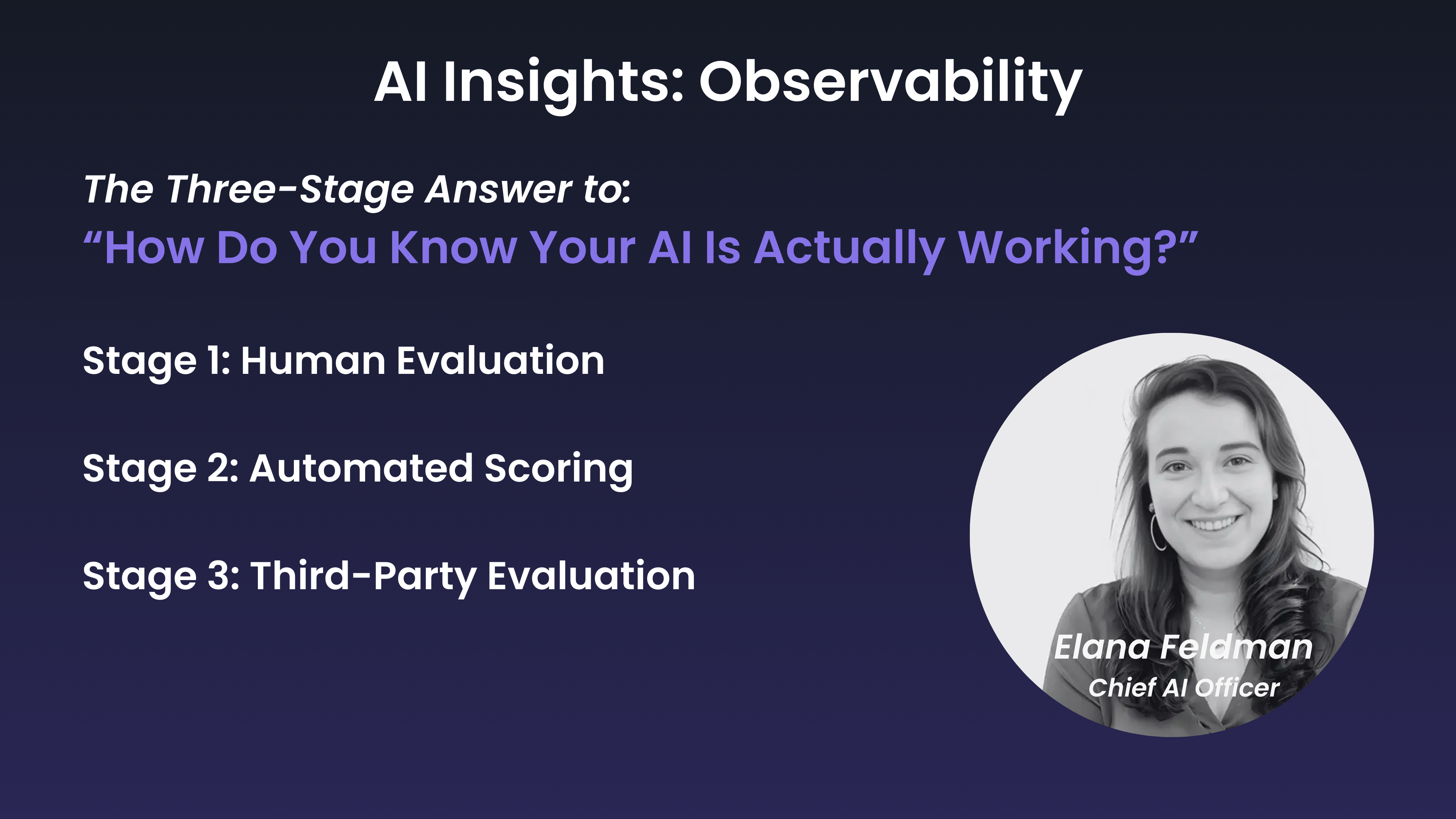
At Pypestream, our expert AI practitioners build solutions that approach this challenge using a structured observability framework that evaluates AI systems in the same way organizations evaluate human service teams: real interactions and measurable outcomes. Every AI deployment moves through three stages designed to define success clearly, measure it consistently, and monitor performance continuously once the system of agents is live.
Stage 1: Human Evaluation
The first stage is human evaluation. Before an AI agent is released broadly, our experts review real test conversations with the system and ask simple but critical questions: What went well? What felt confusing or unhelpful? What responses would we never want a customer to see?
While it may sound obvious, carefully reviewing transcripts is one of the most overlooked steps in many AI deployments. This is where issues surface that no prompt engineer can anticipate, including unusual phrasings from users, responses that are technically correct but practically unhelpful, and edge cases that only emerge when real customer behavior appears. These observations form the foundation for a structured evaluation rubric that guides the rest of the process.
Stage 2: Automated Scoring
In the second stage, that rubric becomes a formal scoring framework. Each conversation is evaluated across five dimensions: tone, communication, accuracy, relevance, and resolution. These categories are intentionally mapped to specific components of the solution architecture. For example, tone scores reflect how well our Knowledge AI Agent adheres to brand guidelines, while relevance scores help evaluate how effectively retrieval and knowledge sources match user intent. This architectural mapping is important because it allows teams to quickly diagnose where improvements are needed. If a category scores poorly, teams know exactly which part of the system to investigate. Certain issues, however, bypass scoring entirely. Bias, hallucinations, data leakage, and unprofessional responses are treated as automatic disqualifiers and must be addressed immediately.
This stage also establishes calibration between human reviewers. The goal is to reach consistent scoring across evaluators, typically targeting roughly 90% agreement. Once teams have achieved this level of alignment, they have effectively defined what “good” performance looks like for their AI system.
Stage 3: Third-Party Evaluation
The third stage introduces continuous evaluation by using an LLM as a judge. A separate model, often from a different provider to avoid shared biases, reviews conversations and scores them against the same rubric used during human evaluation. Because the criteria have already been defined and calibrated during earlier stages, organizations can now apply that judgment consistently across thousands or millions of interactions. This allows teams to monitor performance at scale and in real time. Continuous scoring provides early visibility into issues such as model drift, changes in tone, or declining accuracy rates. Instead of discovering problems after they impact customers, teams can identify subtle shifts in performance as they emerge and address them before they escalate.
The Complete Observability Framework
Together, these three stages create a practical observability framework for enterprise AI systems that moves beyond model metrics and focuses on the outcomes businesses actually care about: higher accuracy leads to higher resolution rates, clearer communication improves customer satisfaction, and better relevance reduces unnecessary escalations to human agents.
When used correctly, an observability framework is not simply a report that gets handed over. It becomes a collaborative process that builds confidence over time. As teams review performance, identify opportunities for improvement, and refine the system together, the AI solution continues to mature. In the first weeks, clients are often excited by what the AI can do. A few weeks later, something more important happens: they stop asking about the AI itself. Instead, the conversation shifts to a new question: what else can we build?